"Do This; Don't Do That"
We Should Not Do Most of the Things We are Doing and Do Many of the Things We are Not Doing


You can say it any number of ways. We used the phrase “opportunity costs” in a previous post, to demonstrate that when you choose to do certain things, by definition you don’t do other things. This time we’ll make two separate lists to make the contrast more explicit. One of us took a crack at the stuff the Trump administration is doing. The other took a swing at the stuff the administration is not doing, which in some ways is the flip side of the first. Neither list is exhaustive, but together they demonstrate choices made and opportunities lost.
Feel free to contest the proposition or throw in a few examples of your own with a comment or criticism.
Stuff We Are Doing
Alongside Israel, the United States initiated an unprovoked war with Iran without a guiding strategy or game plan, even though Iran’s nuclear program had been “totally obliterated”—in the words of our president—in targeted attacks just months before. The Strait of Hormuz has remained suspended in a state of crazy double-blockaded animation ever since, trapping 20 percent of the world’s oil and gas and causing prices of energy and (soon) everything else to soar.
The administration has slapped arbitrary tariffs on the goods of all other countries, be they free-trade partners, economic rivals, or gobsmacked innocent bystanders. These tariffs have since been declared unconstitutional by the Supreme Court, whereupon the administration slapped on new tariffs with a new justification, prolonging the economic uncertainty associated with an unpredictable tariff regime. Meantime, the administration is grudgingly reimbursing billions of dollars to businesses (but not to consumers) for the costs of the first round of unconstitutional tariffs.
The administration is destroying what remains of good government at the federal level across the board, appointing loyalists and hacks to leadership positions while firing or causing competent career professionals to quit. The hemorrhaging of accumulated talent, expertise and experience is incalculable.
Ditto for US science supremacy and science education and universities and education in general, including the goal to close down the Department of Education—a cause without a point. It literally boggles the mind.
The administration is gratuitously undermining our strategic alliances in Europe, East Asia, and beyond, triggering the hedging of former friends and rivals alike, creating momentum for the emergence of a broad anti-US coalition, and empowering the strategic standing of enemies and potential enemies.
The administration continues to murder unknown people in boats, without even the semblance of due process. The total number killed in this way is now slouching toward 200.
The administration continues to terrorize, kidnap, and detain extrajudicially otherwise innocent immigrants (and some US citizens) with or without documentation, for seeking to make a living in this country doing mostly jobs that American citizens don’t want to do. Apart from the humanitarian disgrace, the toll on our economy is like a ticking time bomb.
The administration has killed American citizen protestors in cold blood on the streets in full public view, and then determined that no investigation is necessary. Really?
The administration has weaponized the Department of Justice and used it as a tool to target political rivals, upending and inverting our longstanding commitment to the rule of law. (Don’t even try to compare this with what Biden or any other president in recent memory did.)
The administration has demolished the East Wing of the White House outside of any existing public building process and is planning to build a gigantic ballroom (at newly announced cost of $1 billion of taxpayer money to make the bunker-like structure secure) that the American people don’t want in its place. It has seized other public properties in the nation’s capital aiming to convert them into private, high-end, members-only clubs.
Besides slapping his name on prominent buildings like the U.S. Institute for Peace and the Kennedy Center and now planning to paste a photo of himself on US passports, the president plans to build a massive arch of triumph monument to his own ego on the hallowed grounds between Arlington cemetery and the Lincoln Memorial.
The president, his family, friends, and administration insiders are making a killing with unprecedented and unprecedentedly brazen corruption, converting the highest public office in the land into a massive private money-making operation for a privileged few. To the extent that the administration has a policy on AI, probably the single greatest challenge facing the nation if not the species, that policy seems to be “give all the decision-making power to a handful of tech giants that are hostile to democracy, tell government to get out of the way, and then see what happens.”
The president is turning the United States from a stolid, predictable, and mostly boring pillar of global stability to an erratic and mercurial menace to society, a first-class laughing stock nation and exemplar of gratuitous and astonishing self-sabotage. Is this what he means by the country is so “hot” we’re on fire?

Stuff We are Not Doing
So here’s the other list. Not surprisingly, much of it is the other side of the “what we are doing” coin. Opportunity costs!
We aren’t taking care of the basic health needs of our people. Getting sick can bankrupt you in the United States. Affluent people get far better healthcare than less affluent people, some of whom get none. About 27 million Americans, roughly seven percent of the population, don’t have health insurance at all. The good news? As a percentage, that’s lower than 10 years ago. Why? Because of the Affordable Care Act (Obamacare); increased employer health coverage; and Medicaid expansion. The bad news? We’re moving in the wrong direction. The Big Beautiful Bill mandates tighter eligibility and some work requirements for Medicaid, and eliminates certain subsidies for Obamacare, all of which make health insurance less accessible and less affordable. The United States is the only high-income democracy that doesn’t provide universal healthcare. The only one. We could also talk about hunger and housing, but we’ll leave them for another day.
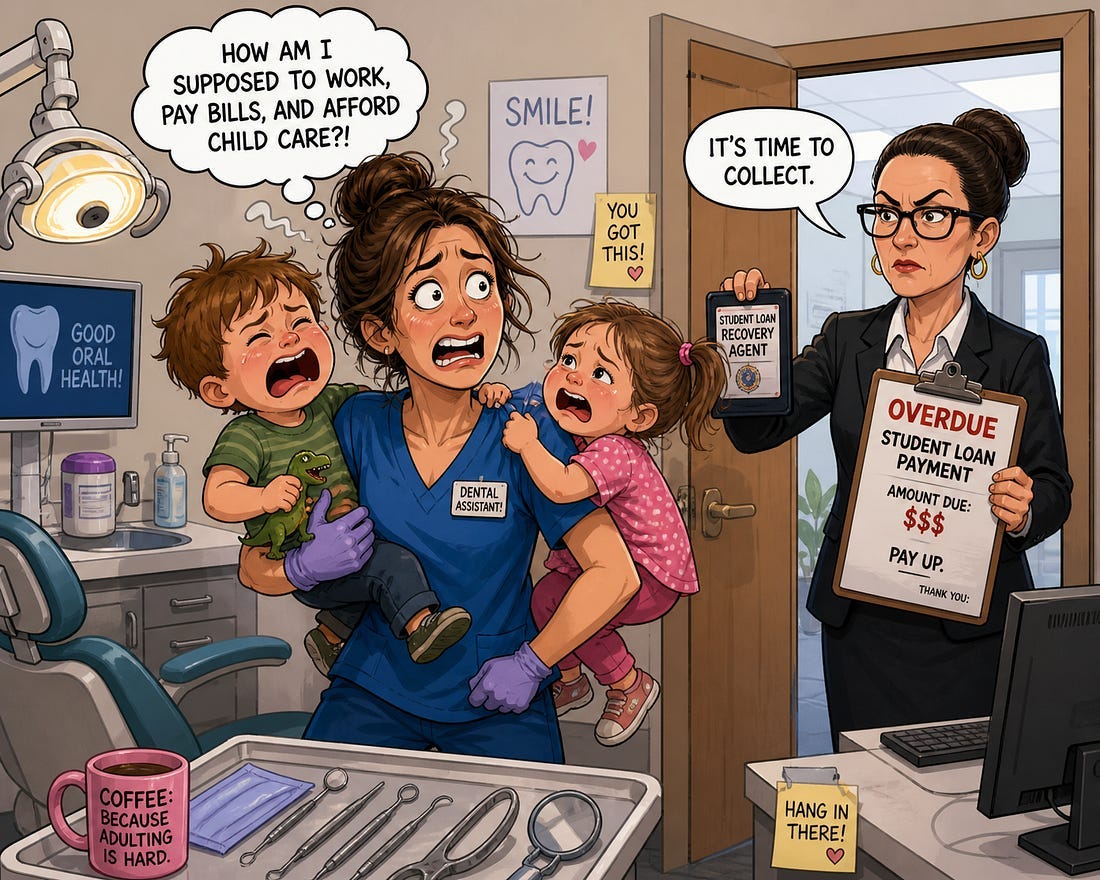
We aren’t providing support for childcare and early education. A local service provider in our town told me she spent 30,000 dollars last year on childcare. Let’s say she earns 60,000 dollars a year, and pays her taxes. She’s left with about 20,000 dollars to feed her three kids, pay the rent, buy clothes and provide everything else that kids need. In Germany, the average annual cost of childcare is about 1500 dollars.
We aren’t tending our partnerships and alliances. In fact, we seem to be intentionally destroying them. If you’d asked any foreign policy expert 10 years ago if they’d trade places with China, they would have laughed. The U.S. had 50 fifty important treaty partners and strategic allies; China had none (unless you count North Korea). The list of self-inflicted wounds is long, tragic and embarrassing: A willy-nilly system of tariffs that upended the global trading system of which we’ve been the primary beneficiary; trolling of Canada (”the 51st state”) and its Prime Minister (”Governor”); did any country ever have a better friend than Canada?; the disgraceful Greenland debacle and threats to invade Denmark, a NATO ally; the cringeworthy Oval Office meeting with Zelensky, and the inexplicable policy of favoring Russia over Ukraine and Europe; the elimination of USAID, our flagship soft power vehicle around the world; and a more general, intentional policy of weakening the international system over which we’ve presided for 80 years and which has made us the most powerful and prosperous country on earth. When someone writes “The Decline and Fall of the American Empire”, chapter one will be called “Trump’s Perverse Recipe for Disaster”.
Having spent 34 years as a diplomat, I’m going to pile on here a bit. Imagine if the Russian government had published a National Security Strategy 10 years ago that said the following: We aim to break up the Americans’ system of partnerships and alliances; specifically we want to weaken NATO; we want to undermine the strong partnerships between the U.S. and Canada and the U.S. and the UK; we want to convince the Americans to support us if we invade a European country, and blame the country we invaded; we want to encourage the United States to threaten to seize territory from its friends and allies; we want the U.S. to pull back from global leadership and the international system that they created after World War II; we want the U.S. to pull troops out of Europe; we want the United States to eliminate USAID, its flagship soft power element that has done so much good and created so many friends for the U.S.; and we want the United States to get bogged down in another unwinnable middle eastern war. In short, we want the United States to unilaterally give up its role as world leader. Even Putin couldn’t have expected it to come true.
We don’t have an education system that meets the moment and prepares our kids for the world they will live in. This shouldn’t be a huge surprise. Our Secretary of Education is a professional wrestling executive; our Secretary of Labor, recently fired for incompetence, was, well, incompetent. The President himself never mentions education except in the context of wanting to eliminate the Department of Education. Cost is a huge factor in the United States, as these figures demonstrate: The average cost of public university (tuition only) in the U.S. is 12,000 dollars in-state and 32,000 dollars out of state; for private universities it averages over 60,000 dollars. This saddles American students with enormous debt. In contrast, average tuition in Japan is under 10,000 dollars, in Germany under 3,000 dollars, and in China under 2,000 dollars.
How about vocational education, which until recently was stigmatized in the United States? The average yearly tuition in the U.S. varies wildly depending on the field, but can cost as much as 20,000 dollars per year. In Japan it averages under 9,000 dollars, in Germany it is often free, and in China it averages under 1,500 dollars a year. Why do we put our young people at such an overwhelming disadvantage compared to their peers in other countries? So if healthcare and childcare don’t break your bank, higher education probably will. Why does the U.S. stand alone in making these core necessities unaffordable for so many?
We haven’t implemented a rational immigration policy. If Trump 2.0 had a mandate, he had a mandate to revamp a broken immigration system. Instead, in true American fashion, we whip-sawed from an overly permissive policy during the Biden Administration to an overly repressive policy under Trump. In fact, we are a nation of immigrants and always have been, and our national “business model” depends on a steady stream of immigrants. Without immigration, the U.S. will face a demographic catastrophe, not unlike what China and Japan and various western European countries already face. In addition, to state the obvious, immigrants fill positions that people born in the U.S. don’t want. Every country has the right and the obligation to have an immigration policy that serves its national security and economic interests. A zero tolerance policy towards immigration is another self-inflicted wound that is unnecessary, self-defeating, and eventually ruinous.
***
In sum, it strikes us that we should not be doing a lot of the stuff we are doing; and, just as importantly, we should be doing a lot of stuff we are not. Do you agree?
We welcome your comments and constructive criticism.
Thanks for reading Unbreaking News: Notes From the Other Side! Subscribe for free to receive new posts, support our work, and join the public conversation about the eternal present and the future.
 | A guest post by
|
I would think this should make excellent campaign material for all mid term elections and certainly for the eventual presidential elections. Certainly the list will continue to grow as our economy begins to suffer, so please share version 2.0 in another few months.
This piece captures something real and important, and the two-list framework, of what we're doing vs. what we're not doing, is a useful analytical structure. Good analysis. But the question it raises to me is if these policies are economically harmful to most American families, why do a majority of Republican voters, including working-class and middle-class families facing exactly these costs, continue to support them so strongly? Five of seven Trump-backed challengers just won Indiana Republican primary races. Clearly, they are responding to a different set of incentives and grievances.
Another question is why has the Democratic Party, which claims to champion working families, so consistently failed to make economic relief — on childcare, healthcare costs, and education debt — the center of its identity rather than cultural and social issues that alienate many of the very voters it needs?
I believe our electoral system currently rewards candidates for exploiting grievances rather than solving problems. My eye is on the senate race in Alaska that pits a moderate Democrat against a Trump Republican. With its ranked-choice voting I am hoping that moderate, solutions-oriented candidates can have a real path to winning.
Mary Peltola, the moderate Democrat and first Alaska Native elected to Congress, is challenging incumbent Republican Sen. Dan Sullivan in what has rapidly become one of the most watched Senate races of the 2026 cycle. This is the cleanest real-world test of what may be an answer to right and left extremism. I keep thinking that the most important thing I can do is to find ways to support ranked-choice voting in swing states Am I wrong?