Baseball
Slowballs and Slower Balls

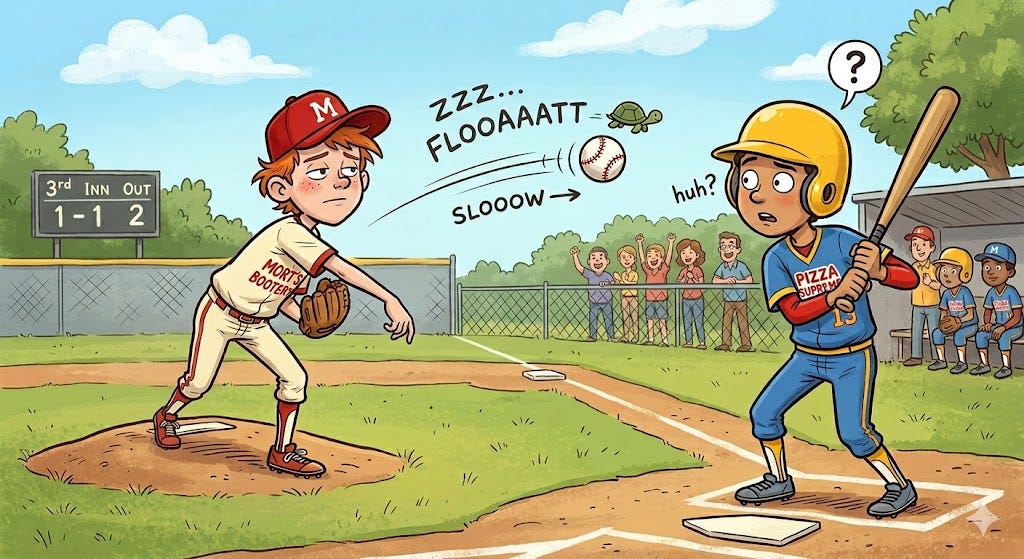
The opening day of baseball season is later this week. I’ve been following baseball since 1961 but I still get excited at the prospect of the new season. Maybe this is our year! Maybe not. The prospect of the new season made me reflect on my own baseball career.
As a very young boy, I learned what was important in life. Baseball. It probably started with my mother, who was a Washington Senators fan – a fan of both the old, pre-expansion team that eventually moved to Minnesota after the 1960 season; and the “new” expansion Senators who dwelled in the cellar of the American League from 1961 until their departure for Texas after the 1971 season.
I still have her scrapbooks from the 1930s, in which she’d paste clippings from the Washington Post and Evening Star, and make comments about her favorite players, like Buddy Myer and Stan Spence.
When I was seven she taught me how to read a box score in the newspaper, and showed me that on Sundays the Washington Post listed every player in both leagues and the accumulated statistics for the year. In 1962 she took me to my first baseball game – the Senators vs. the powerful and hated Yankees of Maris, Mantle, Ford, and the rest. She taught me how to keep score and enjoy the nuances of the game.
I assumed that since I had become an eight-year-old expert on the game, memorizing statistics, collecting baseball cards, poring over box scores, and developing a sophisticated appreciation for all aspects of the game, that I’d naturally be a great player as well.
I wasn’t. Though not for lack of trying. My friends and I played baseball and it’s many variants every day after school and on weekends: Sandlot games, wiffle ball, pickle, home run derby – we played all the time and honed our skills at hitting, pitching, throwing and catching.
In the summer of 1963 I signed up for Little League. One of the neighbors agreed to coach, and put all of the neighborhood kids on his team, which was great. Our yellow shirts said “E.J. Hooper, Builders” but those shirts may as well have sported pinstripes and NY in gothic script. We wouldn’t have been prouder.
Hooper’s fortunes more or less mirrored those of the Senators. We didn’t win many games, and I didn’t exactly tear the cover off the ball. The next year, however, I moved up from Single A to Double A ball, and my Mort’s Bootery team was a juggernaut. I actually got some hits, and the coach, who liked the accuracy if not the velocity of my arm, decided that I could pitch.
If you’re a football player, you want to play quarterback. If you’re a banker, you want to be on Wall Street. If you play baseball, you want to be a pitcher, and I really wanted to pitch. In the evenings I would practice with my father. Unlike my mother, the lifelong fan, my father wasn’t interested in baseball. He didn’t follow it, and hadn’t played much. But he bought a catcher’s mitt and was happy to squat down in the backyard, a can of beer at his side, and catch my heat.
At the next game, our starting pitcher was getting hammered, not an uncommon occurrence in Little League, where 22-17 isn’t a high scoring game. So the coach yanked our starter with one out and the bases loaded in the fourth inning and brought me in from my usual position at second base. I was able to strike out a Lilliputian kid with thick glasses to end the inning and the threat. Like the strapping farm boy in the movie who amazes the scouts and goes on to win the World Series, my pitching career was off and running. I got through the next two innings with only minor damage, we won the game, and a star was born.
A week later the coach decided that I should pitch against league leaders Pizza Supreme. When they write about the great teams – the ’27 Yankees, the Big Red Machine, the Gashouse Gang- they mention Pizza Supreme in the same breath.
Well, those pizza pie boys never had a chance. When old men get together in McLean, and the talk turns to baseball as it always does, they talk about that 1964 game between Mort’s Bootery and Pizza Supreme. Remember that kid, the young righthander – what was his name? – beat Pizza Supreme 8-6. And I did.
What was the key to my success? Well, most little league pitchers just reared back and heaved it. You knew what was coming and you either hit it or you didn’t. These guys were one-trick ponies who lived and died by their fastballs.
At the tender age of nine, I had two things going for me on the mound. First, I could actually throw the ball over the plate, and didn’t walk many batters. And second, I had developed two pitches, which doubled my chances for success and kept batters off balance.
Carl Hubbell had the screwball. Ed Walsh was the last of the great spitballers. Hoyt Wilhem had the knuckleball. Nolan Ryan just blew them away with the heat. My meat and potatoes pitch was the slowball. This pitch behaves much like a fastball, but it’s much slower. My second pitch was my changeup. This pitch behaves much like a slowball, but it’s much slower. Normally I’d start ‘em off with the slowball. Mesmerized by the anti-gravity properties of this pitch – why didn’t the ball just fall to the ground at that speed? – they’d take the first called strike. Then I’d bring the changeup. Stupefied that anything could be slower than the slowball, they’d take a second strike, bat on shoulder. To finish them off I’d throw another changeup. Some batters, unable to wait, would run towards the mound, swinging wildly. Others, thinking that time had been called because nothing was happening , would step out of the batter’s box. But the results were the same, strike three and sit down.
As I say, we beat Pizza Supreme 8-6 that day. My jubilant team members carried me off the field, then dropped me on the gravel path leading to the snack bar where the coach was buying everyone a victory Sno-cone. I pitched again, and played a lot more baseball, but nothing ever surpassed that complete game victory over the league champs for sheer glory.
I still love baseball, though like everything else, it ain’t what it used to be. In the mid-1960s my friend Steve’s father enrolled us in the Knothole Club at D.C. Stadium. As proud Club members, we could get into Senators games for a dollar. We’d join the other 5,000 or so fans in that cavernous park and root for our last-place heroes. It was a different game. We ate hot dogs and peanuts. We clapped along with the organ player and yelled “charge” when he cued us. The second baseman was a slick fielder but couldn’t hit. There were double steals, bunts, triples, suicide squeezes, plays at the plate, and you really had to crank it to hit it out of the park, like our hero Frank Howard.
One dollar tickets? My friend Rich took me to a game last summer and there were signs for 60 dollar parking. I’m not sure how much beers were at D.C. Stadium in 1965, but I know my father didn’t pay fourteen dollars for a beer like I did last summer at Nationals Park in DC.
Was baseball better back then? Hard to say. I guess it’s exciting that guys can throw the ball 105 miles an hour now but truly, wouldn’t you really rather see the slowball?
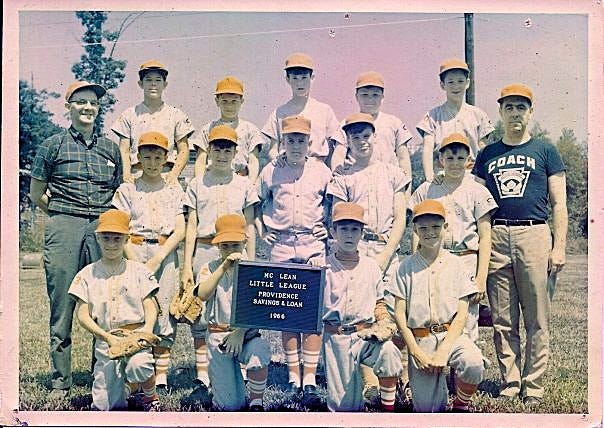
I couldn’t find a picture of my Mort’s Bootery team. This is from the next year, when I got “promoted” to the majors. I’m the second kid from the left in the back row - the smallest guy on the team.
James, reading your post felt like catching a fly ball I didn’t know was coming—pure reflex joy.
Your mother teaching you to read a box score, your father squatting in the backyard with his catcher’s mitt and his beer, the Pizza Supreme game that old men in McLean still invoke in hushed tones—this is baseball as it was meant to be lived. Not just watched. Inhabited.
I came to it the same way. Little League, Pony League, Legion ball in a small North Carolina town where the major leagues might as well have been on the moon. No big newspaper, no TV station worth the name. Every morning I’d call the local paper just to get the scores—Cubs and Red Sox, my two chosen instruments of heartbreak.
And yes, I chose them both. Voluntarily.
That’s the thing about baseball that separates it from every other sport. You don’t have to be 7 feet tall or weigh 300 pounds. You just have to run like the wind and keep your eye on the ball—things every kid on every playground already believes he can do. The game invites you in at age seven and never quite lets you go.
I’ve sat in Wrigley Field on a warm spring afternoon, slight breeze off the lake, grass impossibly green, my Cubbies actually winning. I’ve been in nearly every major league park this country has. And in 2004, after a lifetime of Red Sox purgatory, I watched them come back from 3-1 against the Yankees—the Yankees—and then sweep the Cardinals in four. I wept. I’m not embarrassed to say it.
You asked whether baseball was better back then. I don’t know either. But I know what you mean. One-dollar Knothole Club tickets. The organ. Frank Howard actually having to earn a home run. The slowball.
Maybe it’s less about better and more about before—before we knew how it would go, before the heartbreaks had accumulated, when every April still felt like the year it was all going to turn around.
Maybe this is our year.
Pizza Supreme, yeah. They were still talking about them, even across the river in MoCo, even when I started pee wee baseball in 1974. I never knew you were the Pizza Supreme Slayer, though. I tip my cap to you, sir.